A Bridge Too Far
As residents and businesses flee California, Sacramento invests in improving commute times for mountain lions.

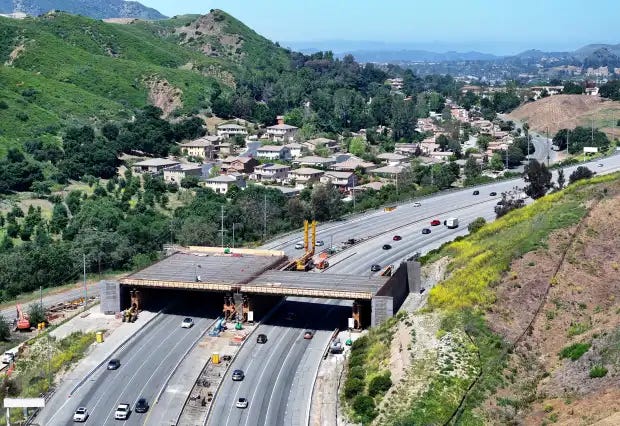
Four miles from my home in Hidden Hills -- roughly the distance it takes a coyote to ruin your morning -- rises California’s newest monument to well-meaning excess: the $114 million Wallace Annenberg Wildlife Bridge spanning Route 101.
For years, on my drive to work at the Ronald Reagan Presidential Library, I watched this structure take shape. It’s an architectural reminder that in California, we no longer solve problems as much as commission them at nine figures.
The premise is noble enough: helping wildlife cross the freeway safely. But like most noble ideas under Progressive-party rule in Sacramento, it collapses under the weight of one small, inconvenient fact: there is already plenty of wildlife here. An abundance, really. A thriving, well-fed, unapologetically carnivorous abundance.
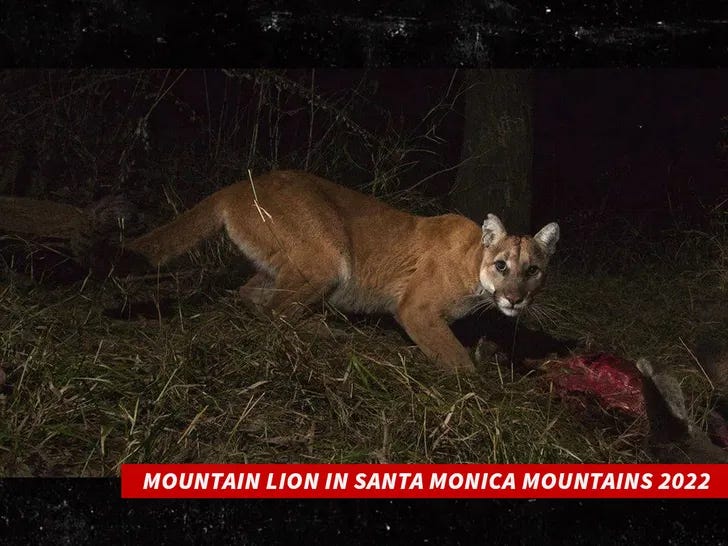
From Ventura County to Pasadena and beyond, we don’t need to import more mountain lions. We have a subscription.
On average, a resident in my neighborhood of Hidden Hills (also known as “where the Kardashians live”) loses a dog or cat to coyotes and the occasional large cat every week. These are not strays. Not reckless explorers. Beloved pets, in fenced yards, during broad daylight, often within sight of their owners. The phrase “secure backyard” has become less a description and more a punchline.
Which brings us to the bridge: a taxpayer-funded wildlife concierge service meant to make it easier for predators to expand their dining choices.
You can call it conservation. The pets call it Uber Eats.
To better understand local sentiment, I commissioned a survey -- arguably the most honest one conducted in California this year -- of 60 residents who experience firsthand the consequences of “enhanced wildlife mobility.” The respondents were dogs, cats, and horses living on my street.
Their verdict was…decisive.
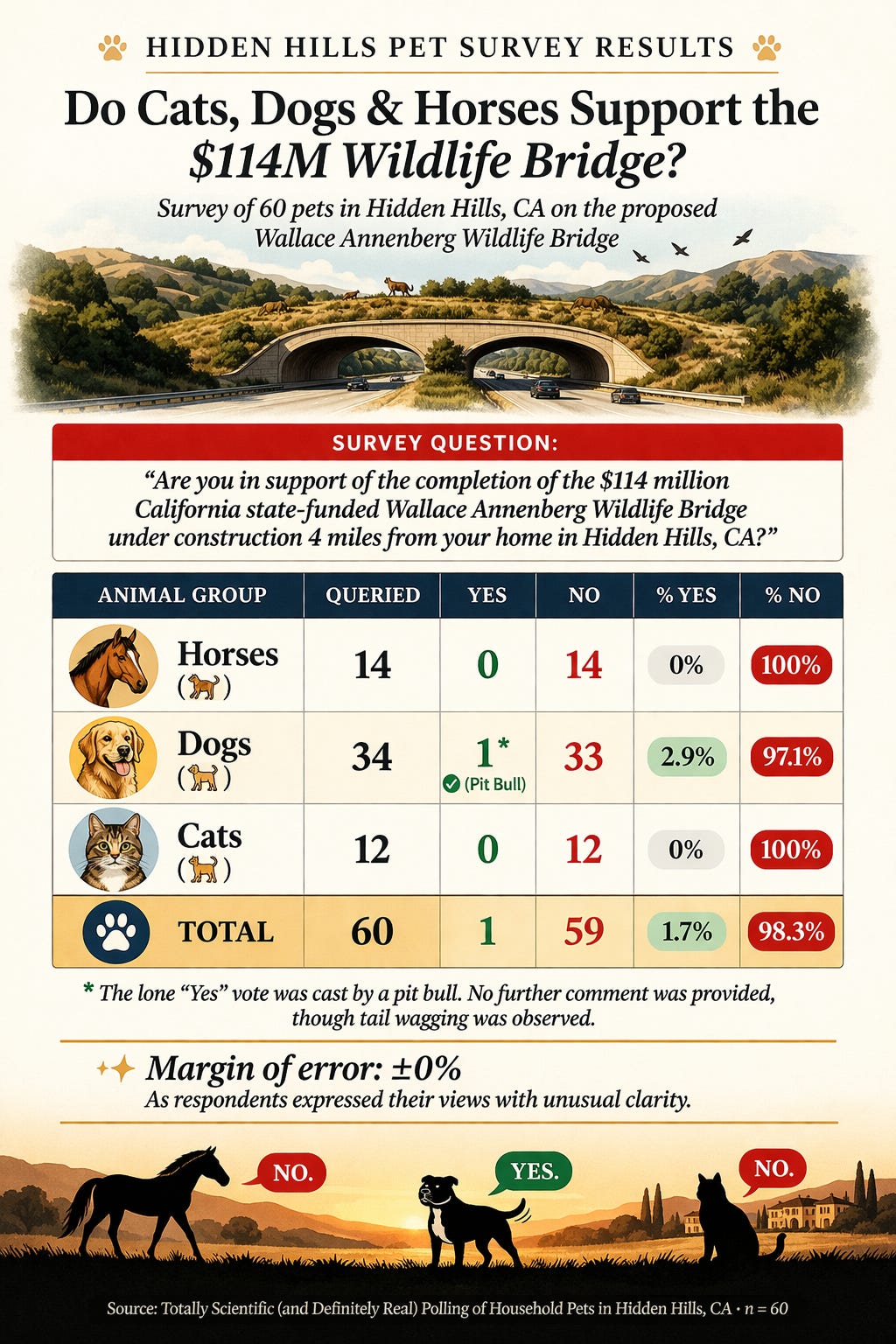
Out of 60 surveyed, 59 opposed the bridge. The only supporter? A pit bull. No further comment was given, though tail wagging was seen, possibly at the chance of finally getting some revenge on a mountain lion in a more formal setting.
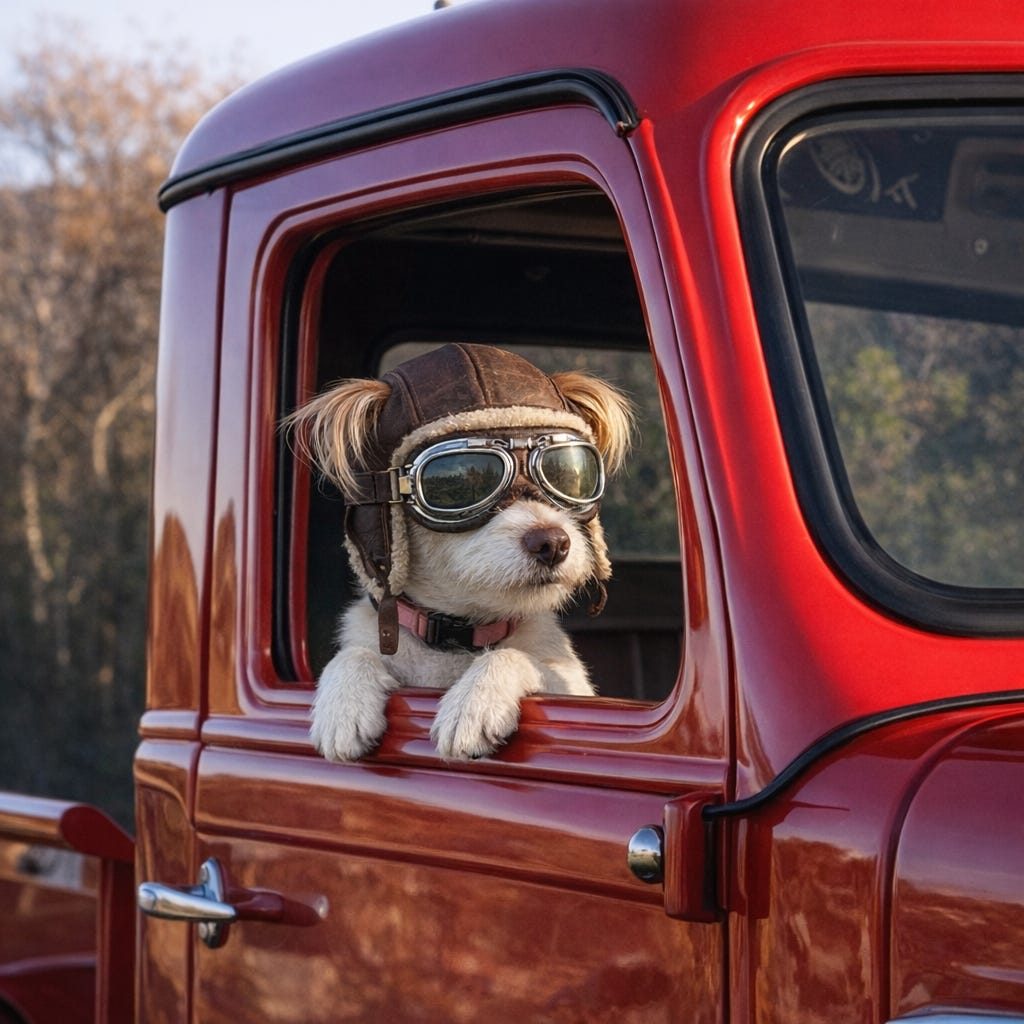
The rest, including our own dog, Lulu (pictured below), were, well, less enthusiastic.
Horses, large enough to be mistaken for confidence itself, voted 14–0 against. Cats, who fear nothing and respect no one, also went 12–0 in opposition, a rare show of unanimity from a species that generally refuses to agree even with gravity. Dogs, normally open to new experiences (mail carriers notwithstanding), came in at 33–1 against.
When animals reject a policy that’s supposed to help other animals at a 98.3% rate, it might be time to rethink the approach, or at least stop building bridges.
But in California, the reasoning works differently. We are told this is about coexistence, balance, and harmony between humans and nature. It’s a lovely idea, as long as you’re not the one being harmonized.
Governor Gavin Newsom has overseen a state where residents are leaving, businesses are relocating, and costs continue to rise steadily into the stratosphere. Housing? Out of reach. Taxes? Sky-high. Regulations? Plentiful enough to require their own migration corridor.
And yet, when faced with these challenges, Sacramento looked at its checkbook and said: You know what we need? A better commute for mountain lions.
It would be one thing if this were just a rounding error. It is not. One hundred and fourteen million dollars is not a rounding error. It’s a statement. A statement that, in California, priorities are no longer merely misplaced; they are actively sightseeing.
Imagine explaining this to a family who just lost their dog to a predator.
“We’re very sorry,” you might say. “But take comfort in knowing that somewhere, a mountain lion is enjoying a more convenient crossing experience.”
This is the moment when the defenders of the bridge invoke the broader ecological vision. Wildlife corridors! Genetic diversity! Long-term sustainability!
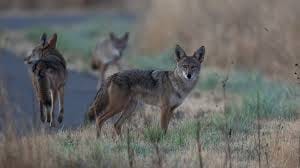
All worthy goals, on paper. But here, in practice, sustainability already has a face. It resembles a coyote trotting through a neighborhood at dusk—completely comfortable, entirely unbothered, and uninterested in waiting for a bridge.
Nature, it turns out, does not require a ribbon-cutting ceremony.
What it truly requires, as it always has, is a balance between preservation and practicality. The bridge isn’t just unnecessary; it’s symbolic. It embodies, in one sweeping curve of concrete, the core philosophy of modern California: when a problem arises, spend extravagantly to address its abstract version, while the real one prowls your own backyard.
The politicians might be committed. The environmentalists might be applauding. But our own animals -- the ones experiencing the consequences -- have spoken with remarkable clarity.
And they are not impressed.
Oh...I think tbe bridge is very useful! The butterflies need it! Newsome said it was necessary for the coyotes, mountain lions and butterflies! The poor Monach butterflies need a bridge to walk over! How could we not support that? Oh, let's not forget the berserk! The toddlers in the back yards make a very nice lunch for the bears! The most valuable part of the bridge is when sitting bumper to bumper young can carefully read that the Annenberg name can be easily read.
It was hard not to laugh out loud reading your piece, but unfortunately, it perfectly represents how divorced from reality the left is. The choices that affect real life people ( and their pets) are so hideously unimaginable, it gets harder and harder to understand how every single person, regardless of their political
party could accept them. Why can’t folks wake up?